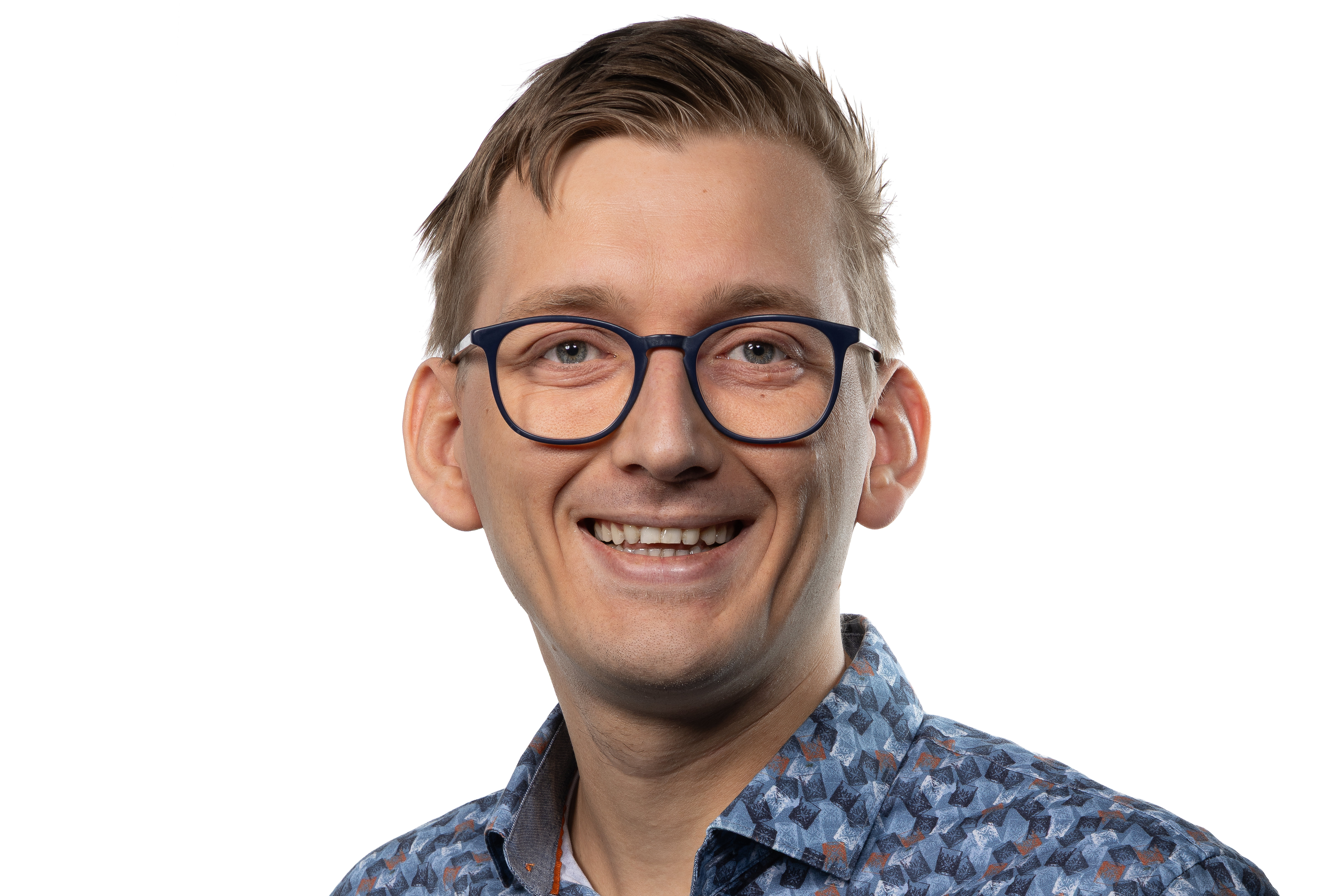
Theoretical physicist Arthur Christianen joined IQOQI Innsbruck as a junior group leader at the start of November. His new Few & Many-Body Quantum Theory Group studies phenomena at the interface of few- and many-body physics in quantum matter, from ultracold atoms and molecules to two-dimensional semiconductors.
Just three interacting particles can already behave in surprisingly complex ways. This is the classic three-body problem, which has fascinated generations of physicists and even inspired a popular Netflix series. Arthur Christianen’s group takes this few-particle perspective as its starting point for tackling open questions in strongly interacting quantum matter. The team combines methods from theoretical chemistry and scattering theory with variational many-body techniques.
A central topic in the group’s research is polaron physics. Here, a single impurity particle immersed in a quantum bath forms a quasiparticle with modified properties. The process resembles solvation in chemistry, where a solvent changes the properties and reactivity of a dissolved substance. However, when the “solvent” is a quantum bath, qualitatively new behavior can emerge. Working with experimental collaborators at MIT, Christianen discovered that potassium atoms immersed in a Bose–Einstein condensate of sodium atoms form a previously unobserved, extremely weakly bound “halo” trimer. The team also found that atoms, molecules and trimers can exist in coherent superpositions of different particle numbers, made possible by the quantum coherence of the “solvent”.
Most recently, Christianen has studied excitons interacting with correlated electrons in two-dimensional semiconductors. With collaborators at ETH Zurich, Heidelberg University and the University of Maryland, he showed how such excitons can probe the vibrations of crystals of electrons and of anyons in fractional quantum Hall states. Earlier, while still a student, he identified a key mechanism behind the long-unexplained loss of ultracold molecules in optical traps. Experiments confirmed his prediction within a year.
Arthur Christianen, born in Nijmegen, the Netherlands, in 1996, studied physics and chemistry at Radboud University Nijmegen. He did his doctoral research at the Max Planck Institute of Quantum Optics (MPQ) in Garching under Ignacio Cirac and Richard Schmidt and received his PhD summa cum laude from the Technical University of Munich in 2023. His thesis won the MCQST PhD Award. After a short postdoc at MPQ, he joined ETH Zurich in 2024 as an ETH Postdoctoral Fellow in the groups of Ataç İmamoğlu and Eugene Demler. He is now building his own research group at IQOQI Innsbruck.