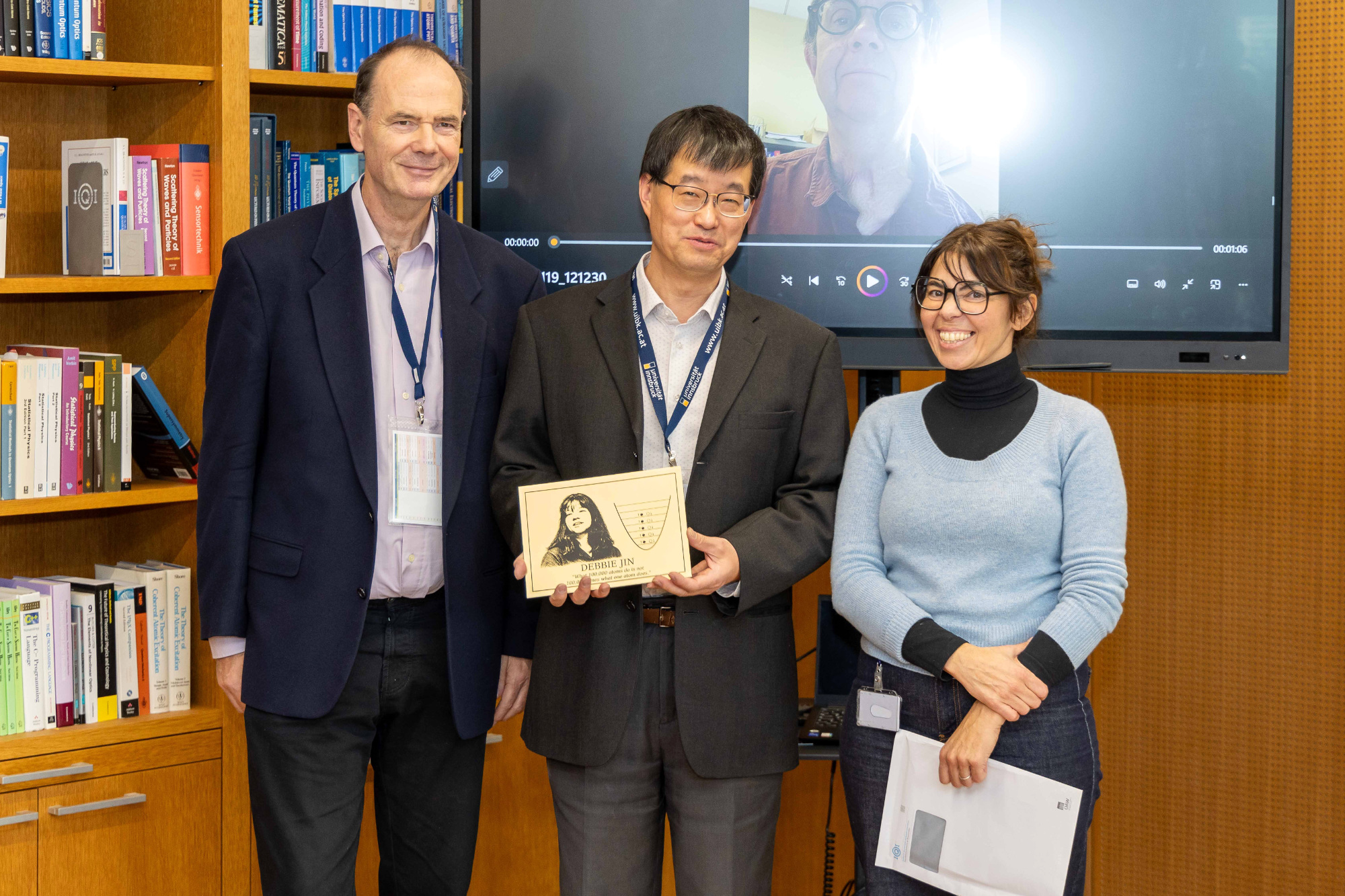
IQOQI Innsbruck has named its library the “Debbie Jin Salon”. The room honors the pioneering experimental physicist Deborah S. Jin (1968–2016), whose work founded the field of ultracold Fermi gases. It is meant to become a place for exchange, discussion and inspiration.
On 24 November 2026, during a symposium honoring Rudolf Grimm, the “Debbie Jin Salon” was officially inaugurated. In his opening words, Grimm reflected on the many links between IQOQI and Debbie Jin. Nobel laureate Eric Cornell, who worked with Jin at JILA, sent a personal message for the occasion. Jun Ye, Jin’s close colleague at JILA in Boulder, then spoke about her scientific achievements.
“Debbie Jin was a truly exceptional scientist,” says Francesca Ferlaino, who initiated the dedication. “She was not simply a pioneer in her field; she was one of those rare individuals whose creativity, courage, and scientific vision opened an entirely new direction of research.”
Opening a new frontier
At the microscopic level, particles belong to two fundamentally different families: bosons and fermions. In 1995, researchers first produced a Bose–Einstein condensate, cooling bosonic atoms into a remarkable quantum state close to absolute zero. Fermions were much harder to cool. Because of the Pauli exclusion principle, identical fermions cannot undergo the low-temperature collisions that conventional evaporative cooling relies on. Debbie Jin was among the first to find an ingenious way around this obstacle. In 1999, together with her PhD student Brian DeMarco, she created the world’s first quantum-degenerate atomic Fermi gas. They used two different spin states of potassium-40 atoms to enable the necessary cooling collisions.
This breakthrough opened the field of ultracold fermionic quantum gases and inspired research groups worldwide. Its importance extends well beyond atomic physics. Fermionic atoms are exceptionally clean and controllable systems for mimicking the behavior of electrons in materials. They offer a powerful route to understanding phenomena in condensed-matter physics such as superconductivity.
In a series of groundbreaking experiments in 2003 and 2004, Jin’s group demonstrated the condensation of pairs of fermionic atoms. The group also explored the connection between Bose–Einstein condensation and the Cooper pairing that underlies conventional superconductivity. These experiments helped establish the BEC–BCS crossover, now one of the central research areas in quantum many-body physics.
“It was an extraordinarily exciting period in our field,” Ferlaino recalls. “A small number of pioneering experimental groups were at the forefront of these developments, including Debbie’s group at JILA, Wolfgang Ketterle’s group at MIT, and Rudolf Grimm’s group here in Innsbruck.”
Jin’s curiosity never stopped at the boundaries of an established field. She went on to explore ultracold polar molecules and, together with Jun Ye, achieved another breakthrough by creating ultracold gases of polar molecules. This opened new opportunities for exploring quantum chemistry and molecular quantum physics.
A personal and scientific connection
The dedication reflects a direct scientific link to Innsbruck. “I had the privilege of collaborating with Debbie and John Bohn on the physics of dipolar fermions,” says Ferlaino. “Together with colleagues in Innsbruck and Boulder, we investigated the remarkable collision properties of magnetic fermionic atoms, which led to a joint publication in Physical Review Letters in 2014. This connection makes the dedication of a room at IQOQI to Debbie particularly meaningful to me.”
More than scientific excellence
Debbie Jin’s legacy reaches beyond her research. She was a pillar of the international scientific community. Colleagues admired her creativity and scientific rigour as well as her generosity, integrity and commitment to others.
“As a woman who reached the very highest levels of scientific achievement in a traditionally male-dominated field, Debbie became a role model for an entire generation of women in physics, and for me personally a great inspiration,” says Ferlaino. “But her contribution went far beyond leading by example. She actively supported younger scientists, encouraged women at different stages of their careers, and helped create an environment in which talent, curiosity, and determination could flourish.”
Debbie Jin passed away far too early, in 2016, but her influence remains deeply present in the scientific community.
A room for exchange
With the “Debbie Jin Salon”, IQOQI Innsbruck celebrates both Jin’s scientific legacy and the values she embodied. It is meant to become a place where people meet, exchange ideas, discuss science, share knowledge and inspire one another.
“In a way, this is perhaps the most fitting tribute we can offer: a space dedicated to scientific curiosity, intellectual freedom, and the human connections that make great science possible,” says Ferlaino. “The Debbie Jin Salon will be more than a room bearing the name of an outstanding scientist. It will be a place to keep her spirit, her example, and her inspiration alive for future generations.”
About Deborah S. Jin (1968–2016)
Deborah Shiu-lan Jin was born in 1968 in Stanford, California, and grew up in Florida. She graduated in physics from Princeton University in 1990. In 1995 she earned her PhD at the University of Chicago under Thomas Rosenbaum, with a thesis on heavy-fermion superconductors. She then joined JILA in Boulder as a postdoctoral researcher with Eric Cornell and Carl Wieman. In 1997 she started her own research group at JILA. She later became a NIST Fellow, a JILA Fellow and an adjoint professor of physics at the University of Colorado Boulder. In 2005 she was elected to the US National Academy of Sciences at the age of 36, one of the youngest women ever to be elected. Her many honors include a MacArthur Fellowship (2003), the I. I. Rabi Prize of the American Physical Society (2005), the Benjamin Franklin Medal in Physics (2008), the L’Oréal-UNESCO For Women in Science Award (2013), and both the Comstock Prize in Physics and the Isaac Newton Medal of the Institute of Physics (2014). Debbie Jin died of cancer in Boulder in 2016, at the age of 47. She was married to the JILA theorist John Bohn.