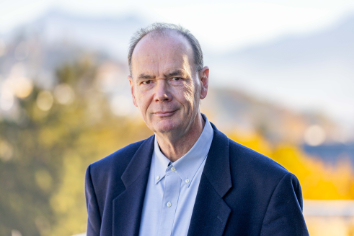
Before devoting himself fully to physics, Rudolf Grimm played guitar in a punk band. He eventually found his true stage in research: as an internationally acclaimed experimental physicist, Wittgenstein Prize laureate and co-founder of the Institute for Quantum Optics and Quantum Information (IQOQI) of the Austrian Academy of Sciences. On Tuesday, 10 November, Rudolf Grimm turns 65.
To mark the occasion, Innsbruck’s quantum physics community is hosting the symposium “The Magic of Ultracold Atoms” from 22 to 24 November 2026. Former students, colleagues and long-time companions will come together to discuss the field Grimm has helped shape for decades: ultracold atoms and quantum gases, along with phenomena such as Bose-Einstein condensation, superfluidity and superconductivity.
From Mannheim via Moscow to Innsbruck
Born in Mannheim, Grimm studied physics at the University of Hannover and received his doctorate from ETH Zurich in 1989. He then spent his postdoctoral years at the Institute of Spectroscopy in Troitsk near Moscow, where his interest in using optical dipole forces to manipulate cold atoms took root. At the Max Planck Institute for Nuclear Physics in Heidelberg, he went on to work on laser cooling of atomic beams and on new methods of trapping atoms with light. In 2000 he accepted a professorship at the University of Innsbruck, where he established the research group “Ultracold Atoms and Quantum Gases”.
Together with Hans Jürgen Briegel, Peter Zoller and Rainer Blatt in Innsbruck and Anton Zeilinger in Vienna, Grimm was among the researchers whose teams built up IQOQI after its founding in 2003. In doing so, he contributed substantially to Austria’s standing today as an internationally recognised center for quantum physics. He served two terms as IQOQI Managing Director, in 2012–2014 and 2022–2024. At the University of Innsbruck, his leadership roles included heading the Faculty of Mathematics, Computer Science and Physics, the Center for Quantum Physics, the Physics research focus and the Department of Experimental Physics.
Pioneering work in the ultracold
The first Bose-Einstein condensate (BEC) was observed in 1995, and a worldwide race followed to create such condensates from ever more elements. Grimm’s team was at the forefront. In 2002 the Innsbruck researchers produced the world’s first BEC of caesium atoms, and a year later the first BEC of molecules. In 2004 came a Fermi condensate, which Science counted among the scientific breakthroughs of the year. In 2006 the group achieved the first experimental observation of the three-body states that the Russian theorist Vitaly Efimov had predicted decades earlier. With the first condensates of strontium (2009) and erbium (2012), the team opened up further elements for research. Also in 2012, it realised a repulsive polaron in an ultracold quantum gas for the first time. This novel quasiparticle lived around ten times longer than in earlier experiments on comparable systems, which opened the way to new observations.
Grimm’s group also attracted outstanding talent to Innsbruck. Francesca Ferlaino joined him as a visiting researcher in 2006 and decided to stay. Today she is herself one of Austria’s leading quantum physicists and was named Austrian Scientist of the Year 2025.
Widely honored
Grimm’s work has earned him numerous honors. In 2005 he received the Wittgenstein Prize of the Austrian Science Fund (FWF), Austria’s highest scientific award. A year later he became a full member of the Austrian Academy of Sciences, and in 2007 a Fellow of the American Physical Society. The Austrian association of education and science journalists named him Scientist of the Year 2009. In 2018 he and Vitaly Efimov were jointly awarded the Faddeev Medal for the prediction and observation of the Efimov effect. In 2021 he received an ERC Advanced Grant and the BEC Senior Award. This year he was also elected to the German National Academy of Sciences Leopoldina. In addition, he has repeatedly been listed among the Highly Cited Researchers.
More time for other things
With his milestone birthday, Grimm is beginning a gradual withdrawal from day-to-day research. He started reducing the size of his group last year, and all ongoing doctoral theses and projects are set to be completed by autumn 2028 at the latest. After that, with fewer responsibilities, he intends to focus on his work at the Academy and on advisory roles. He also looks forward to the many things that found no room in his schedule in recent years. His fascination with science, he emphasises, will never end.
Perhaps he will also pick up his guitar more often again. In the early 1980s, after all, his time as guitarist of “Bärchen und die Milchbubis” earned him a place in the youth magazine Bravo.