
Tyrolean Regional Minister for Science Cornelia Hagele visited IQOQI Innsbruck ahead of International Women's Day. She spoke with Francesca Ferlaino, Scientist of the Year, and attended a get-together with motivated young female scientists from the atom*innen network Ferlaino founded.
The visit by Cornelia Hagele presented an opportunity to discuss current research, the role of Innsbruck as an international hot spot for quantum research, and the importance of women in quantum physics.
Ferlano's path to physics
During the conversation, Francesca Ferlaino first recounted her personal journey into physics. Growing up in Naples with a classical education in Latin and Ancient Greek, she discovered her enthusiasm for science rather unexpectedly: “For me, physics was initially a coincidence – but at a certain point, I knew: I want to understand how nature works.” Today, Ferlaino is one of the most internationally renowned scientists in the field. Her research focuses on quantum gases at ultra-cold temperatures. She was one of the first to observe a supersolid state in the laboratory – an elusive quantum state in which the properties of solids and liquids are simultaneously apparent.
For Ferlaino, Innsbruck offers ideal conditions for her work: “Innsbruck is world-renowned for quantum physics. It was clear to me that if I wanted to learn new techniques and conduct research at the highest level, this was the place to be,” explains the physicist. The close cooperation between the University of Innsbruck, IQOQI, and numerous international partner institutions creates a research environment of the highest standard.
atom*innen: Visibility and Networking
In addition to her scientific work, Ferlaino is committed to promoting equal opportunities in science: in 2024, she founded the international network atom*innen, for which she was awarded the Grete Rehor National Prize. The interactive online platform aims to strengthen the sense of community among women in quantum physics. On the one hand, the platform collects data on gender relations in physics in order to better understand the current situation. On the other hand, it offers a wealth of practical information on support programs, scholarships, awards, and initiatives for women in physics, while also helping to make women more visible: a virtual gallery portrays historical and contemporary female physicists, accompanied by interviews that highlight different career paths. In addition, users can create their own public and visible profiles—a concrete contribution to countering the frequently raised argument that there are no “suitable women” for conferences or commissions. The network also organizes events for exchange and networking to facilitate new contacts and collaborations.
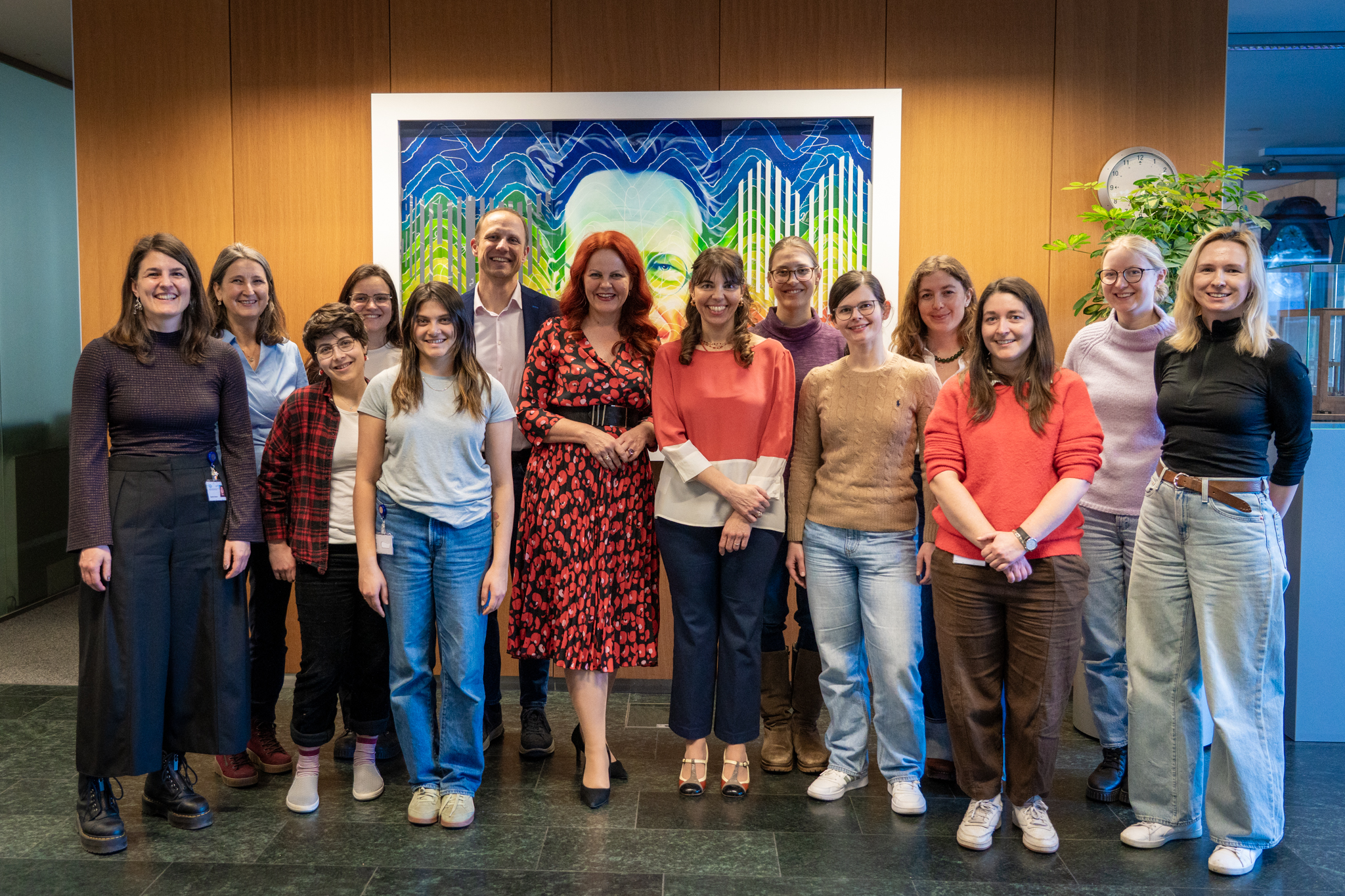
During her visit, State Councilor Hagele also met numerous young female physicists at the institute who are active in the atom*innen network. The exchange highlighted how important such initiatives are for women in science—for example, to realize that they are not alone in their experiences and to strengthen each other. At the same time, such networks also provide an important space for collaboration and for sharing a common fascination with physics.
According to Ferlaino, the proportion of women in physics has hardly changed on average across the EU in recent years, and it is important to work together to break down stereotypes. Hagele also emphasized the importance of accessible role models: „We must not accept that old role models determine the course of our lives. After all, equality begins in the classroom. That is why we must inspire both girls and boys to take an interest in science. Talent ain’t got no gender.“ In order to improve the sometimes still difficult balance between having kids and a career, the state of Tyrol is currently expanding its childcare programs.