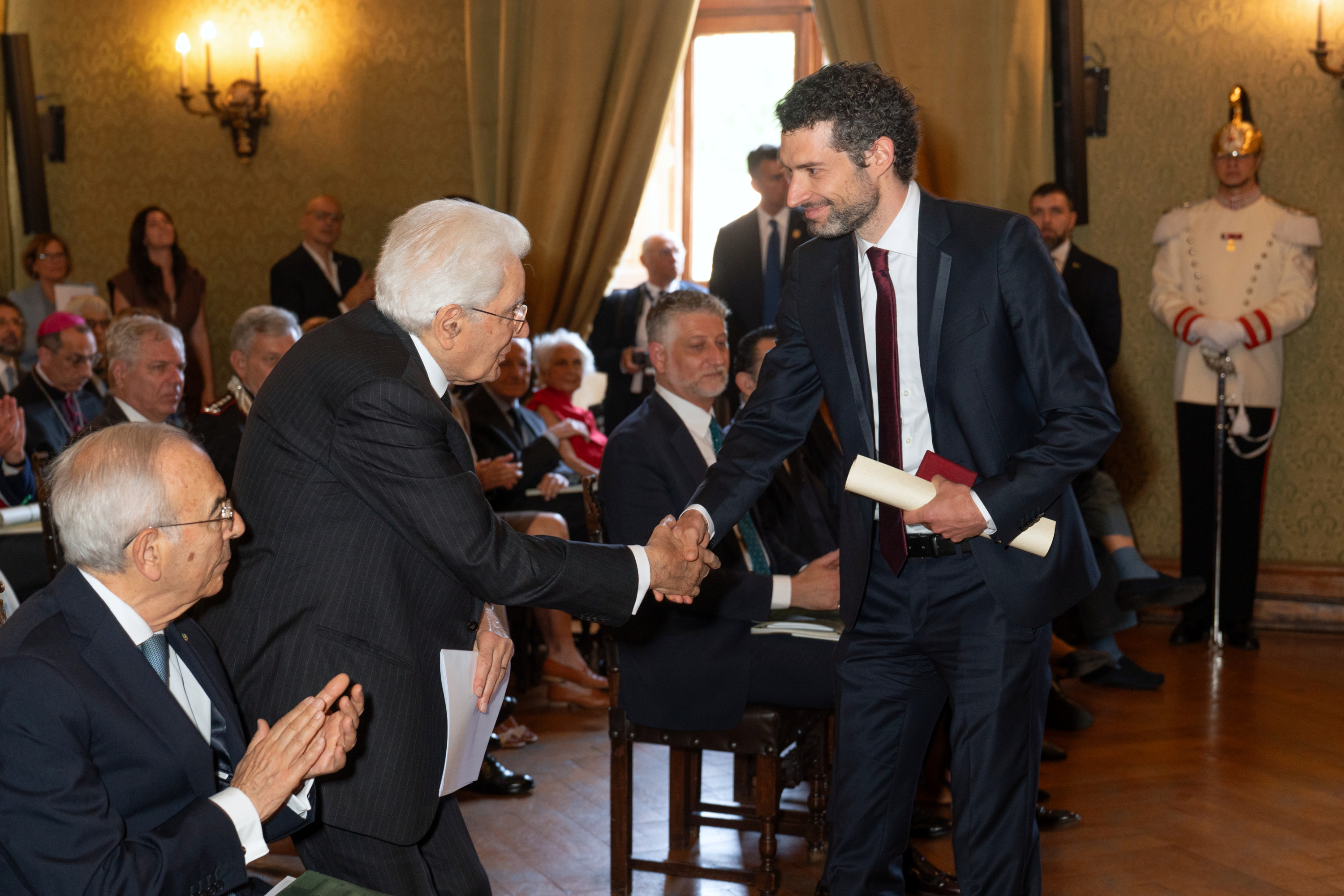
Quantum physicist Hannes Pichler was awarded the Antonio Feltrinelli Giovani Prize in Physics on June 12 in Rome. The 50,000-euro award, presented by the Italian Academy of Sciences, honors researchers under the age of 40 who have achieved exceptional and internationally recognized success in their field.
On June 12, 2026, the Accademia dei Lincei, Italy’s national academy of sciences, awarded the Antonio Feltrinelli Prizes to outstanding figures in science and the arts. The prize ranks among the most prestigious honors of its kind in Italy. Hannes Pichler, a native of South Tyrol, received in the presence of Italian President Sergio Mattarella the Antonio Feltrinelli Giovani Prize in Physics for his pioneering contributions to theoretical physics at the interface between optics, quantum information and many-body phenomena. For Innsbruck quantum physics, this marks another distinction of this kind: in 2017, Francesca Ferlaino was awarded the Antonio Feltrinelli Giovani Prize in Physics.
Frequently honored
Hannes Pichler is a professor of theoretical physics specializing in quantum optics at the University of Innsbruck and a scientific director at the Institute for Quantum Optics and Quantum Information of the Austrian Academy of Sciences. His research focuses on quantum optics, quantum information processing, and quantum many-body physics. He has already received numerous awards: in 2022, Pichler was awarded an ERC Starting Grant from the European Research Council; in 2023, he received the Hans and Walter Thirring Prize and the New Horizons in Physics Prize from the Breakthrough Prize Foundation; and in 2024, he was awarded the Research Prize of the Stiftung Südtiroler Sparkasse and the Ignaz L. Lieben Prize from the Austrian Academy of Sciences.
The “Italian Nobels”
The international grand prizes were awarded to chemist Hiroaku Suga, immunologist Marina Cavazzana, literary scholar Wang Hui, and philologist Furio Brugnolo.
The award goes back to the legacy of the Milanese entrepreneur and financier Antonio Feltrinelli (1887–1942), who wished to dedicate his personal fortune to the promotion of science and the arts. In his will of 1936, he stipulated the establishment of a fund that—following the model of the Nobel Foundation—would honor individuals who have distinguished themselves through outstanding achievements in the arts and sciences. The fund is administered by the Accademia Nazionale dei Lincei, Italy’s oldest scientific academy. On this basis, it awards national and international prizes to individuals who have achieved extraordinary accomplishments in their fields.