

Logo ÖAW
Austrian Academy of Sciences Institute for Quantum Optics and Quantum Information
Logo des Instituts für Quantenoptik und Quanteninformation
  • Facebook
  • Youtube
    • DE
    • EN
  • IQOQI Innsbruck
    • Visitor Information
    • Media and Press
    • Videos
    • IQOQI colloquia
    • Open Positions
    • Partner
    • Prize Postdoctoral Fellowship
    • Thesis Prize
    • Legal Information
    • Mission Statement
  • People
    • Staff
    • Visiting Fellows
    • Guests
    • New at IQOQI
    • Workgroup Staff
    • Administration
  • Research
    • Research Groups
    • Emeritus Research Groups
    • Publications
    • Former Research Groups
    • Austrian University Partners
  • News
    • News
    • In the news
    • Photo Gallery
  • Events
  • IQOQI Vienna
  • Facebook
  • Youtube
    • DE
    • EN
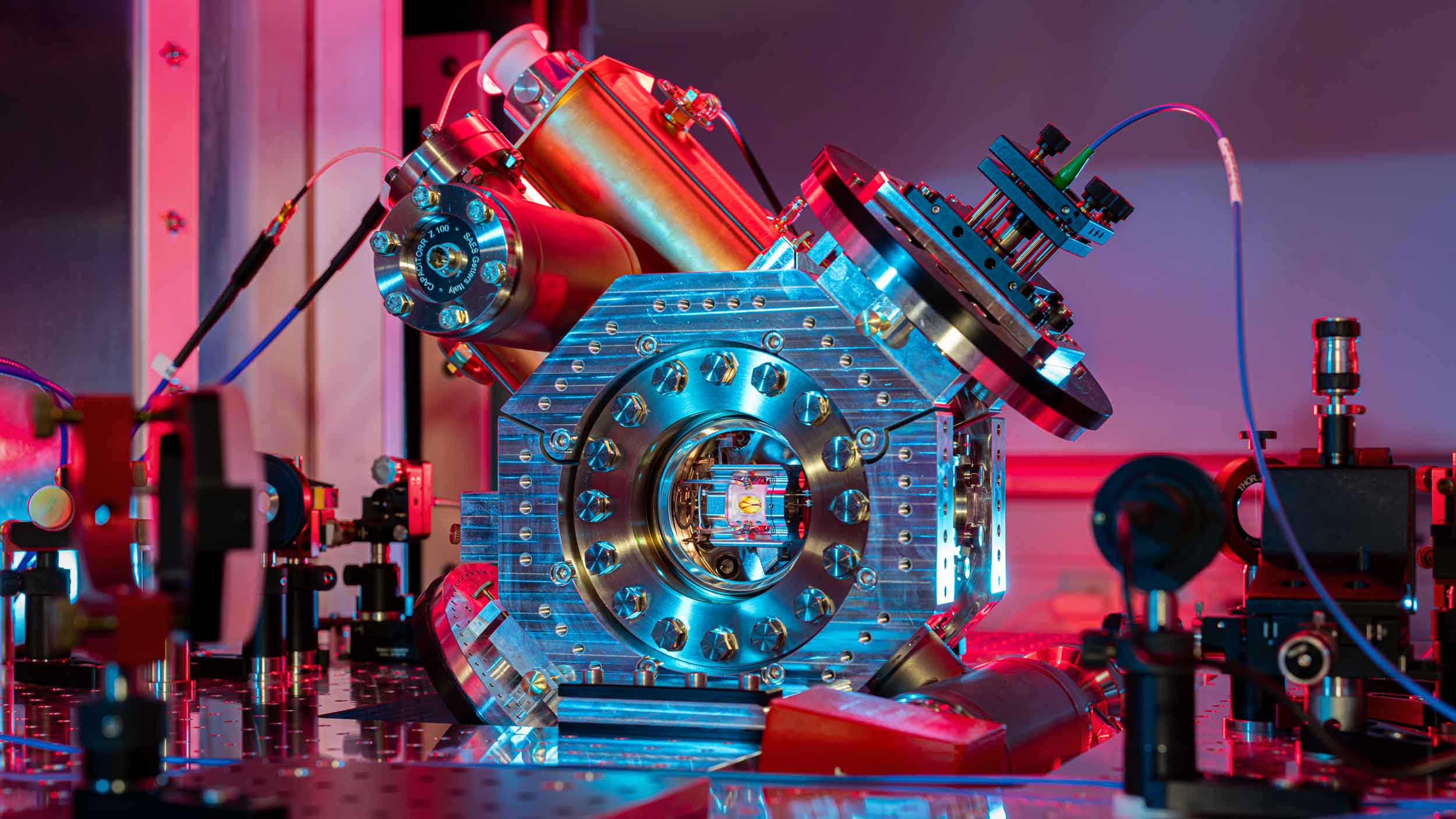
Testing a high power 532nm laser

Testing a high power 532nm laser

Ferlaino group

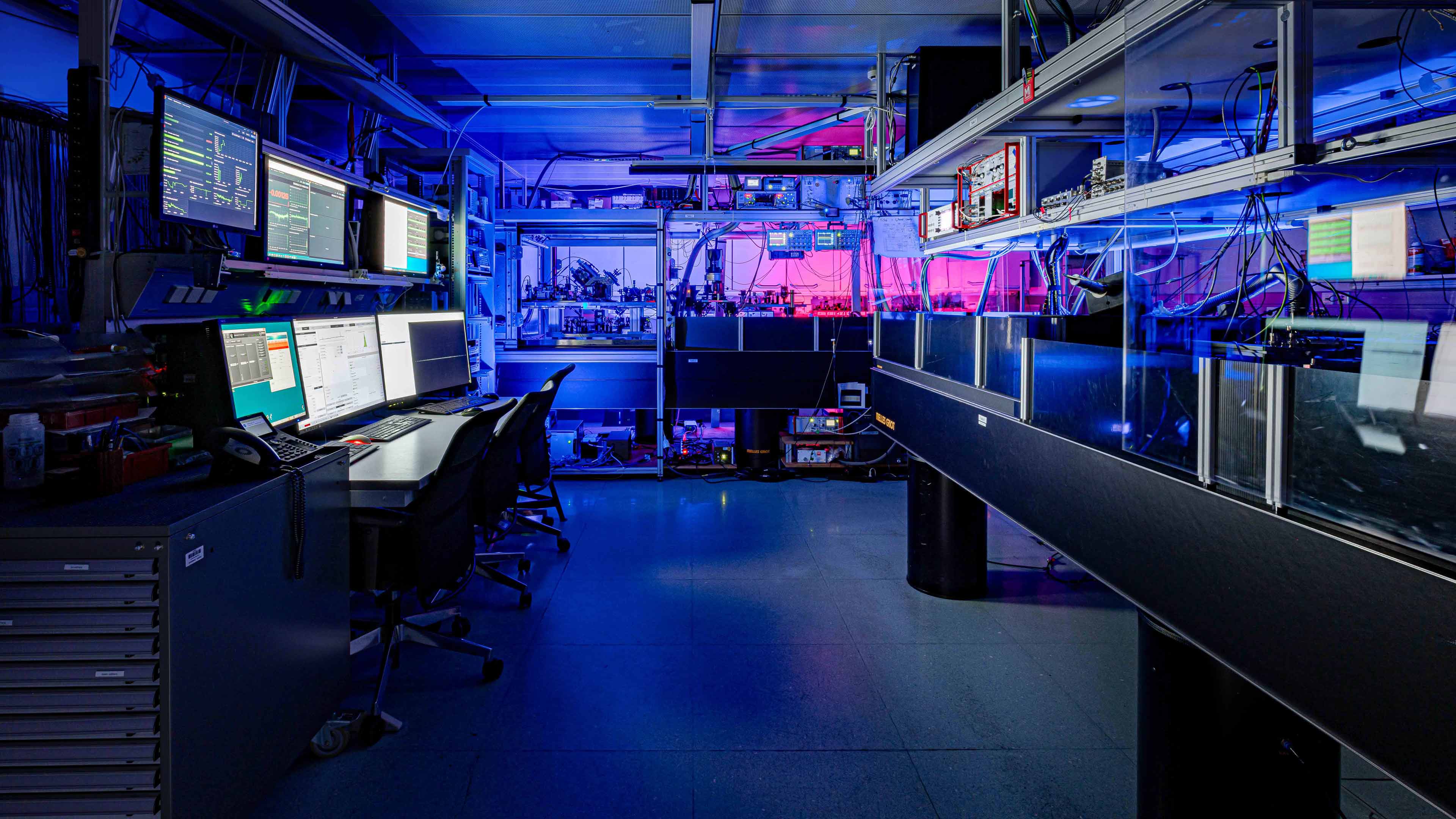
Superconducting Qubits Coupled to a Coplanar Waveguide

Superconducting Qubits Coupled to a Coplanar Waveguide

Kirchmair group

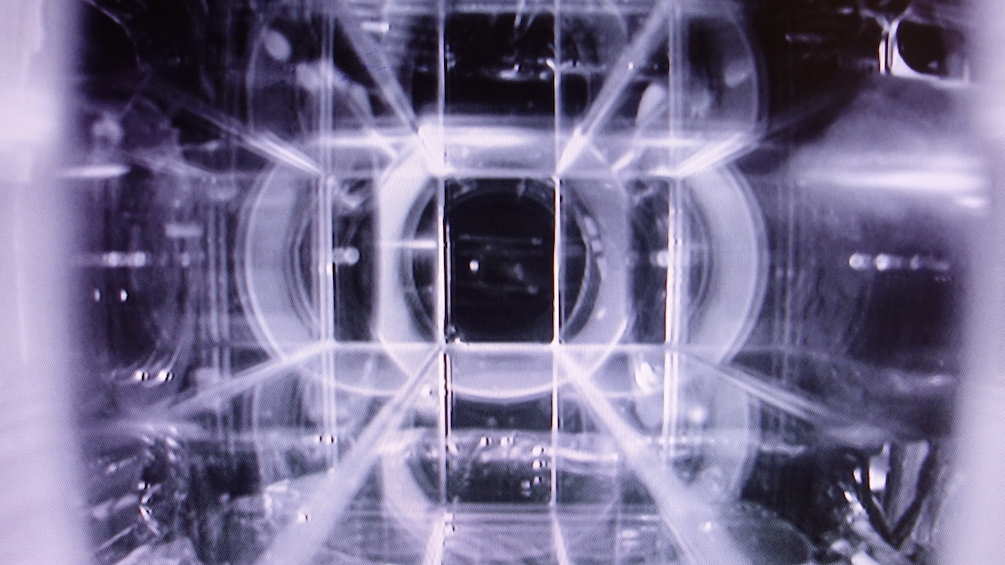
Monolithic ion trap for experiments with 2 dimensional ion crystals

Monolithic ion trap for experiments with 2 dimensional ion crystals

2D Crystals Experiment, AG Roos

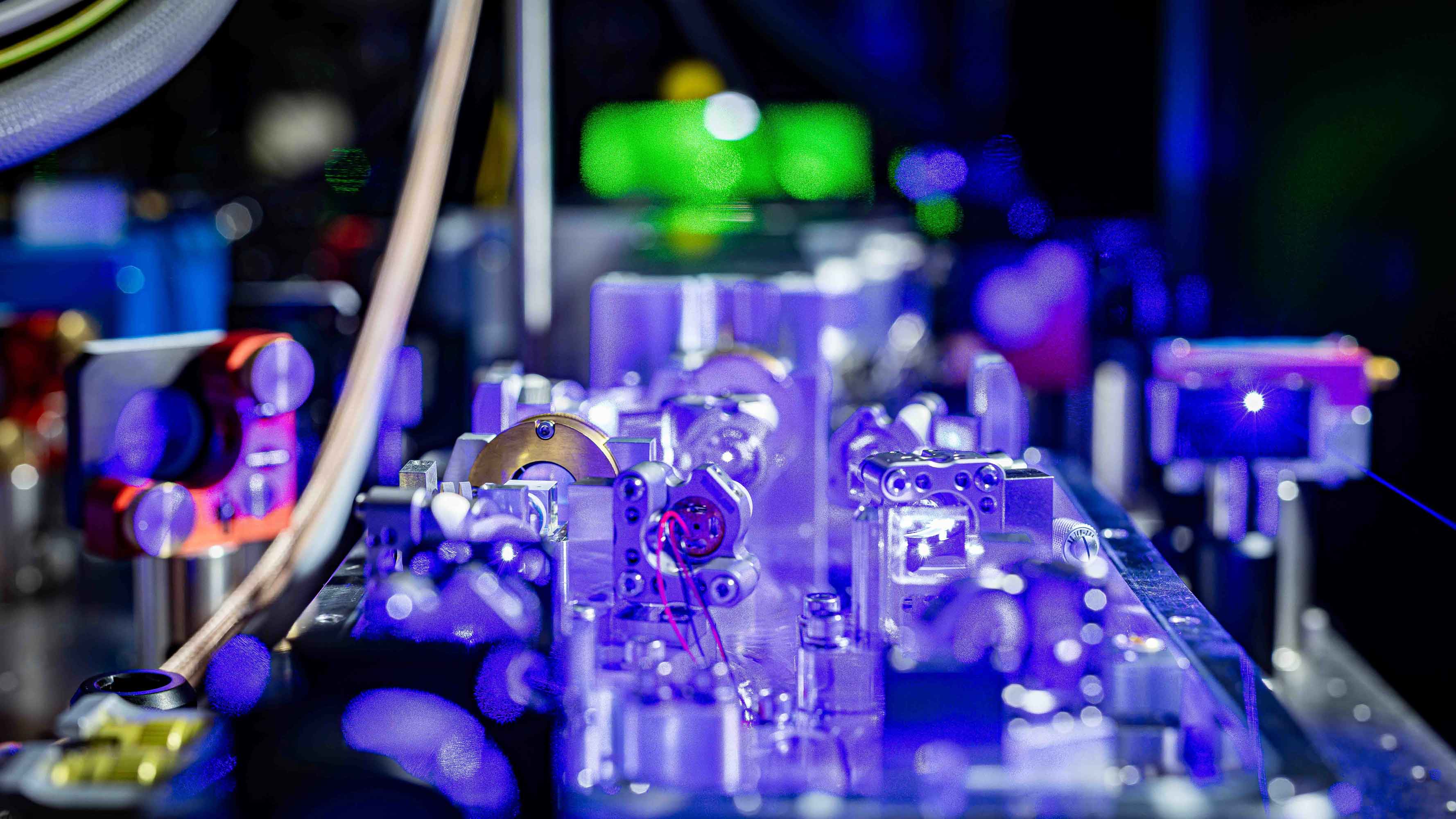
A beam of Lithium atoms undergoing transverse laser cooling

A beam of Lithium atoms undergoing transverse laser cooling

Grimm group

News More News

Photos: David Jordan

New research network granted

The Austrian Science Fund (FWF) has approved a new special research area on quantum systems of... Read Full Article
Photos: Lackner/Shone/Jordan

Three among the most cited

Every year, the data company Clarivate publishes a list of the most cited—and therefore most... Read Full Article
Photo: Matthias Heisler

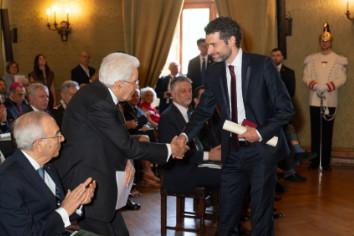
Celebrating quantum research

Austria is a real hotspot on the international quantum physics map. To mark the end of the UNESCO... Read Full Article
Photo: David Jordan

IBM quantum pioneer Jay Gambetta in Innsbruck

This week, Jay Gambetta, Director of IBM Research, visited IQOQI Innsbruck and the University of... Read Full Article

In the News

Physics World Weekly Podcast: 100 Years of Quantum Mechanics

Helgoland: leading scientists reflect on 100 years of quantum physics and look to the future

physicsworld: Schrödinger cat states like it hot

Superpositions persist at temperatures up to 1.8 K – practically oven-like by quantum standards

Research Groups

Bernien Lab - Quantum Science Atom-by-Atom

Foto of Hannes Bernien
The BernienLab studies quantum science by assembling large quantum systems using individual atoms trapped in optical tweezers. This platform is ideally suited to both explore fundamental questions,... Read more …

Ferlaino Lab - Dipolar Quantum Gases

Foto of Francesca Ferlaino
The research team led by Francesca Ferlaino focuses on the study of dipolar quantum phenomena, using strongly magnetic atomic species. In 2012, the group has created the first Bose-Einstein... Read more …

Grimm Lab - Ultracold Atoms and Quantum Gases

Foto of Rudolf Grimm
The research group led by R. GRIMM investigates ultracold particle systems consisting of optically trapped quantum gases at temperatures close to absolute zero. Because of their superb experimental... Read more …

Hammerer Group - Quantum Optics and Quantum Metrology

Foto of Hannes Pichler
The Hammerer group conducts research in theoretical quantum optics, with a particular focus on quantum metrology and precision measurement. We study physical systems that can be described and... Read more …

Kirchmair Lab - Superconducting quantum circuits
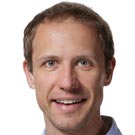
Foto of Gerhard Kirchmair
Gerhard Kirchmair’s research group works on superconducting circuits and their application for quantum computation and simulation. Superconducting Josephson junctions are used to realize the quantum... Read more …

Pichler Group - Quantum Science Theory
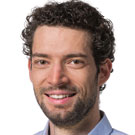
Foto of Hannes Pichler
The research group led by Hannes Pichler studies quantum optical systems, quantum many-body physics and quantum information. The group aims at laying the theoretical foundations for next generation... Read more …

Emeritus Research Groups

Blatt Lab - Quantum Optics and Spectroscopy

Foto of Rainer Blatt
The research group led by Rainer Blatt investigates quantum processes in a system of few ions held in ion traps. The experiments aim at achieving complete control over all quantum degrees of freedom in... Read more …

Zoller Group - Quantum Optics

Foto of Peter Zoller
Wittgenstein awardee Peter Zoller studies topics in the fields of theoretical quantum optics and atomic physics as well as quantum information and condensed matter theory. His main focus is on... Read more …

Most Recent Preprints

Estimating ground-state properties in quantum simulators with global control C. Tabares, D. Wild, I. Cirac, P. Zoller, A. Gonzalez-Tudela, D. González-Cuadra arXiv:2511.04434 Show Abstract
Accurately determining ground-state properties of quantum many-body systems remains one of the major challenges of quantum simulation. In this work, we present a protocol for estimating the ground-state energy using only global time evolution under a target Hamiltonian. This avoids the need for controlled operations that are typically required in conventional quantum phase estimation and extends the algorithm applicability to analog simulators. Our method extracts energy differences from measurements of the Loschmidt echo over an initial ground-state approximation, combines them with direct energy measurements, and solves a set of equations to infer the individual eigenenergies. We benchmark this protocol on free-fermion systems, showing orders-of-magnitude precision gains over direct energy measurements on the initial state, with accuracy improving rapidly with initial-state fidelity and persisting for hundreds of modes. We further demonstrate applicability to the 2D Ising and Fermi-Hubbard models and show that the approach extends naturally to other observables such as order parameters. Finally, we analyze the effect of experimental imperfections and propose error-mitigation strategies. These results establish a practical route to compute physically relevant quantities with high precision using globally controlled quantum simulators.
Neural quantum states for emitter dynamics in waveguide QED T. Vovk, A. Van de Walle, H. Pichler, A. Bohrdt arXiv:2508.08964 Show Abstract
Quantum emitters coupled to one-dimensional waveguides constitute a paradigmatic quantum-optical platform for exploring collective phenomena in open quantum many-body systems. For appropriately spaced emitters, they realize the Dicke model, whose characteristic permutation symmetry allows for efficient exact solutions featuring superradiance. When the emitters are arbitrarily spaced, however, this symmetry is lost and general analytical solutions are no longer available. In this work, we introduce a novel numerical method to study the dynamics of such systems by extending the time-dependent neural quantum state (t-NQS) framework to open quantum systems. We benchmark our approach across a range of waveguide QED settings and compare its performance with tensor-network calculations. Our results demonstrate that the t-NQS approach is competitive with other numerical methods and highlight the potential of t-NQSs for studying open quantum many-body systems out of equilibrium.
Non-local mass superpositions and optical clock interferometry in atomic ensemble quantum networks C. Fromonteil, D. Vasilyev, T. Zache, K. Hammerer, A. M. Rey, J. Ye, H. Pichler, P. Zoller arXiv:2509.19501 Show Abstract
Quantum networks are emerging as powerful platforms for sensing, communication, and fundamental tests of physics. We propose a programmable quantum sensing network based on entangled atomic ensembles, where optical clock qubits emulate mass superpositions in atom and atom-clock interferometry. Our approach uniquely combines scalability to large atom numbers with minimal control requirements, relying only on collective addressing of internal atomic states. This enables the creation of both non-local and local superpositions with spatial separations beyond those achievable in conventional interferometry. Starting from Bell-type seed states distributed via photonic channels, collective operations within atomic ensembles coherently build many-body mass superpositions sensitive to gravitational redshift. The resulting architecture realizes a non-local Ramsey interferometer, with gravitationally induced phase shifts observable in network-based interference patterns. Beyond extending the spatial reach of mass superpositions, our scheme establishes a scalable, programmable platform to probe the interface of quantum mechanics and gravity, and offers a new experimental pathway to test atom and atom-clock interferometer proposals in a network-based quantum laboratory.
Bounded-Error Quantum Simulation via Hamiltonian and Lindbladian Learning T. Kraft, M. K. Joshi, W. LAM, T. Olsacher, F. Kranzl, J. Franke, L. K. Joshi, R. Blatt, A. Smerzi, D. S. França, B. Vermersch, B. Kraus, C. F. Roos, P. Zoller arXiv:2511.23392 Show Abstract
Analog Quantum Simulators offer a route to exploring strongly correlated many-body dynamics beyond classical computation, but their predictive power remains limited by the absence of quantitative error estimation. Establishing rigorous uncertainty bounds is essential for elevating such devices from qualitative demonstrations to quantitative scientific tools. Here we introduce a general framework for bounded-error quantum simulation, which provides predictions for many-body observables with experimentally quantifiable uncertainties. The approach combines Hamiltonian and Lindbladian Learning--a statistically rigorous inference of the coherent and dissipative generators governing the dynamics--with the propagation of their uncertainties into the simulated observables, yielding confidence bounds directly derived from experimental data. We demonstrate this framework on trapped-ion quantum simulators implementing long-range Ising interactions with up to 51 ions, and validate it where classical comparison is possible. We analyze error bounds on two levels. First, we learn an open-system model from experimental data collected in an initial time window of quench dynamics, simulate the corresponding master equation, and quantitatively verify consistency between theoretical predictions and measured dynamics at long times. Second, we establish error bounds directly from experimental measurements alone, without relying on classical simulation--crucial for entering regimes of quantum advantage. The learned models reproduce the experimental evolution within the predicted bounds, demonstrating quantitative reliability and internal consistency. Bounded-error quantum simulation provides a scalable foundation for trusted analog quantum computation, bridging the gap between experimental platforms and predictive many-body physics. The techniques presented here directly extend to digital quantum simulation.
More Preprints
All Publications

Institute for Quantum Optics and
Quantum Information - Innsbruck
of the Austrian Academy of Sciences

Technikerstraße 21a
6020 Innsbruck, Austria


Phone +43 512 507 47100
This email address is being protected from spambots. You need JavaScript enabled to view it.

Open Positions

  • ACADEMY SCIENTIST (F/M/X) in experimental quantum physics

Quicklinks

  • People
  • News
  • Publications
  • About IQOQI
© Copyright OEAW Imprint Data Protection